







Join the Squad Get Rewarded
Unlock early access to FM feature drops, news and reveals before anybody else. Plus, behind-the-scenes insights and incredible members-only giveaways.
Sign for FMFCAlready a member?

We’ve detected that your browser is in English, click the button below to go to the dedicated English version of the Football Manager website.
Go to English site
Hemos detectado que tu navegador está en español. Haz clic en el botón de abajo para ir a la versión del sitio web de Football Manager en este idioma.
Ir al sitio web en español
Nous avons détecté que votre navigateur est en français, cliquez sur le bouton ci-dessous pour vous rendre sur la version en français du site internet de Football Manager.
Allez vers le site en français
Tarayıcınızın dilinin Türkçe olduğunu belirledik. Football Manager web sitesinin Türkçe versiyonuna gitmek için aşağıdaki düğmeye tıklayın.
Türkçe sitemize gidin
Abbiamo rilevato che il tuo browser è in italiano, clicca sul pulsante qui sotto per andare alla versione italiana del sito di Football Manager.
Vai al sito italiano
Wir haben erkannt, dass Ihr Browser auf Deutsch eingestellt ist. Klicken Sie auf die untere Schaltfläche, um zur deutschen Football Manager-Seite zu gelangen.
Zur deutschen SeiteAdd to wishlist now to get launch alerts straight to your inbox.
Whether you’re an experienced FM player or a newcomer to the series, crafting a tactic from scratch is a chance to put your tactical nous to the test.
This process has been streamlined in Football Manager 26 though, and you’ve got more tools at your disposal to build the right approach for the players in your squad.
In this guide, Ihor Crusadertsar introduces you to FM26’s new and reworked striker roles and shows you how to build a dominant two-striker tactic for your next save.

When you’re creating a tactic, starting with the strikers is a good way to go. Building from the front allows you to see what kind of attacking threat your team can present. From here, you can determine how to build around your strikers to get them firing on all cylinders.
Key to that are their Attributes. When it comes to player roles, Attributes are everything. They define whether a player can perform better or worse in one role versus another.
Players work best when assigned to their best role – the one their Attributes are most compatible with – and when in combination with other complementary roles around them.
A simple yet effective way to maximise your strikers in FM26 is a simple 4-4-2 formation.
The 4-4-2 formation is familiar to pretty much every football fan – two banks of four players in defence and midfield and then two strikers leading the line. It’s a fantastic starting shape in FM because it fits almost any club at any competitive level.
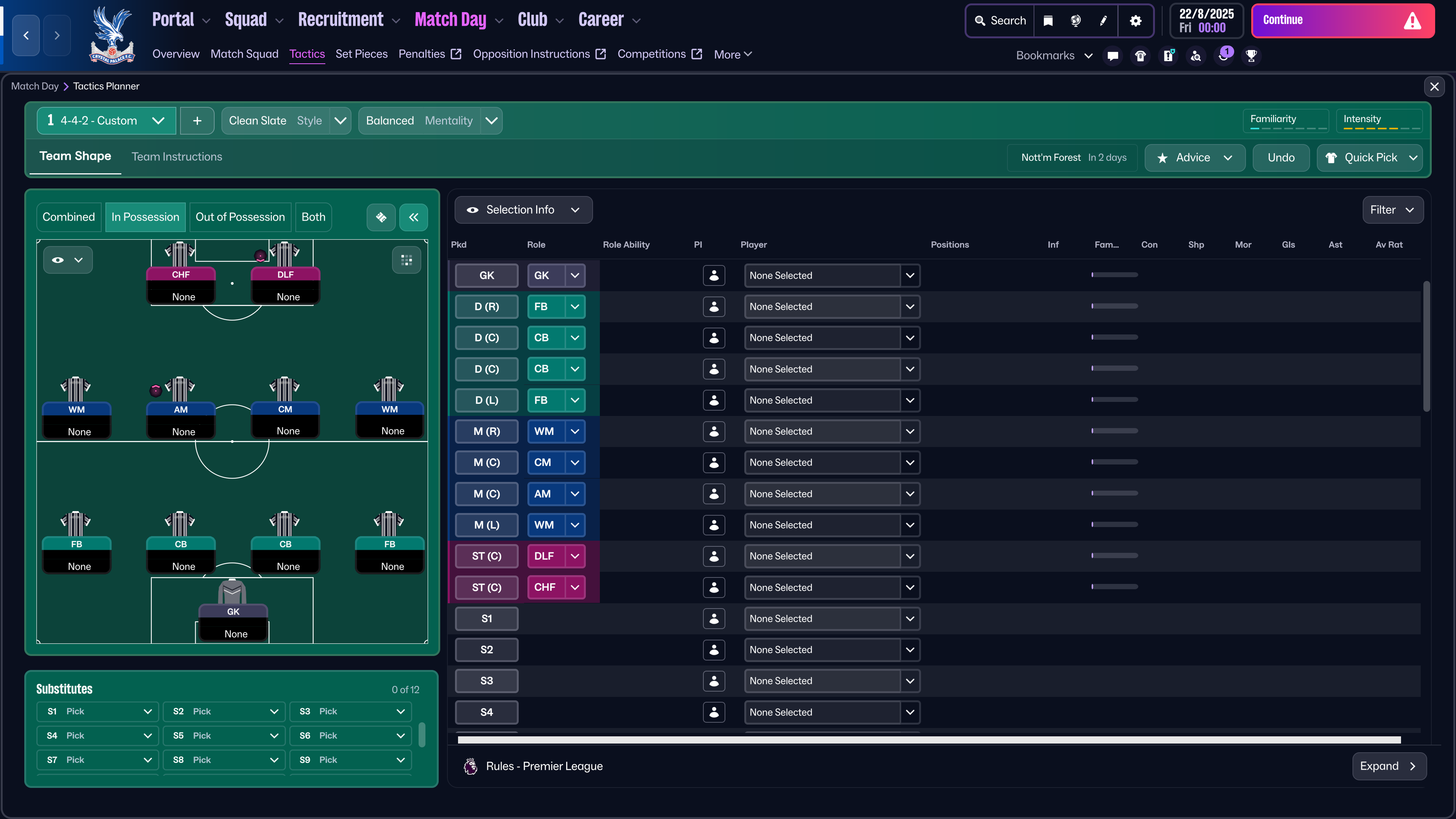
When choosing the two forwards in a 4-4-2, you want them to have complementary strengths so they form the most effective partnership. If one of them is strong, powerful and good in the air, you might want the other striker to be faster and more mobile to pick up second balls.
In this example, we’re managing Premier League club Crystal Palace and working on crafting a 4-4-2 that can compete domestically and in the UEFA Conference League.
We begin by looking for a striker role with the best ‘goal threat’ Attributes. In the role selection screen, you can see right under the striker role name whether it is a role that offers ‘goal threat’. In FM26, there are three in-possession forward roles that are considered to be goal threats - Poacher, Channel Forward and Centre Forward.
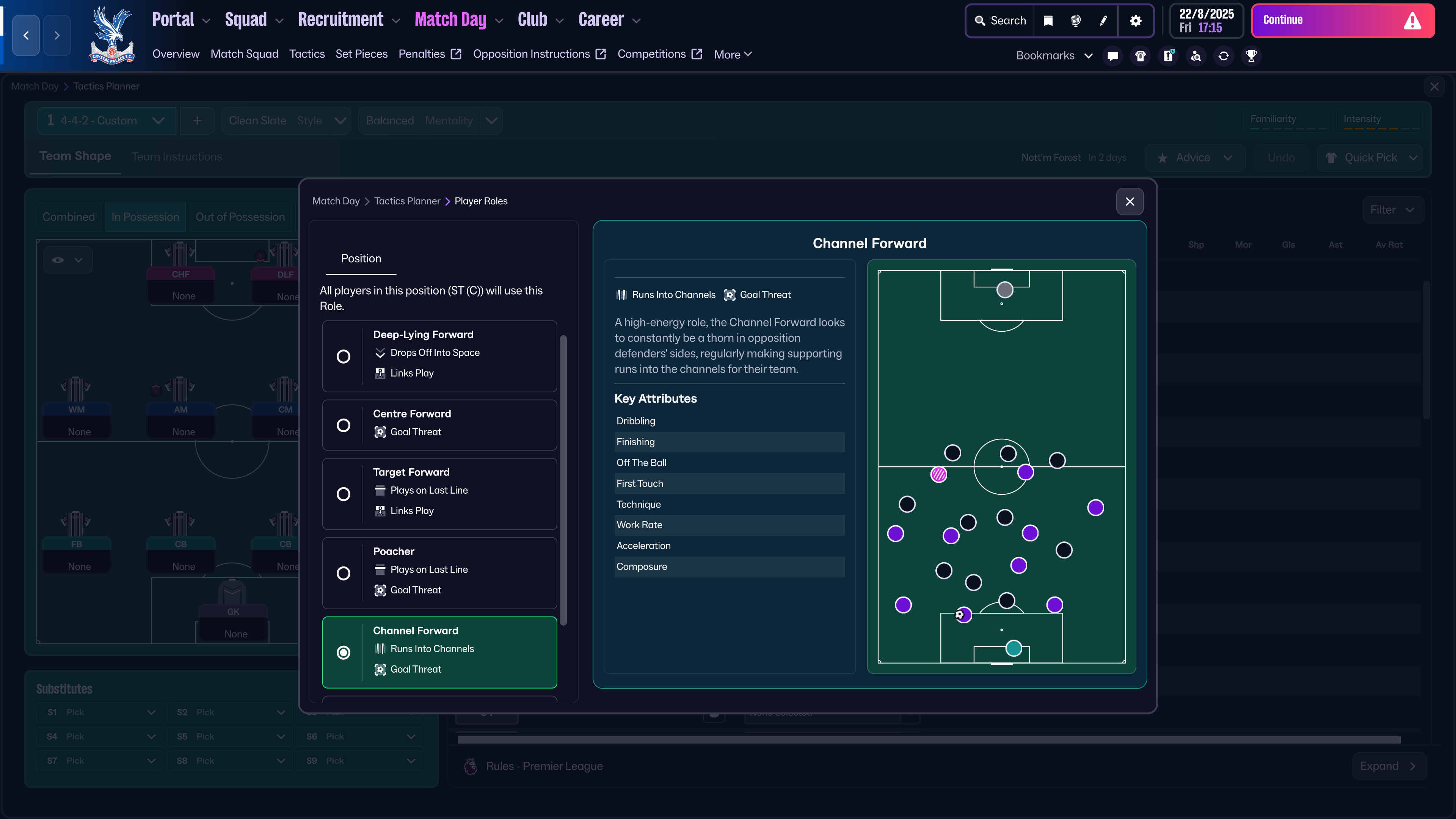
All three of these roles have four key attributes in common: Off The Ball, Acceleration, Composure and Finishing. If a striker has good values in those four Attributes, they could play any of the three roles well.
These Attributes are all interconnected. If a player has good movement off the ball to be available to receive passes in dangerous positions but not the speed to get there, a lot of chances will go begging. Likewise, they need to be instinctive finishers who have the mental composure to focus under pressure and make intelligent decisions with and without the ball.
In the Crystal Palace squad, the player that has the strongest combination of these four Attributes is France international Jean-Phillippe Mateta.
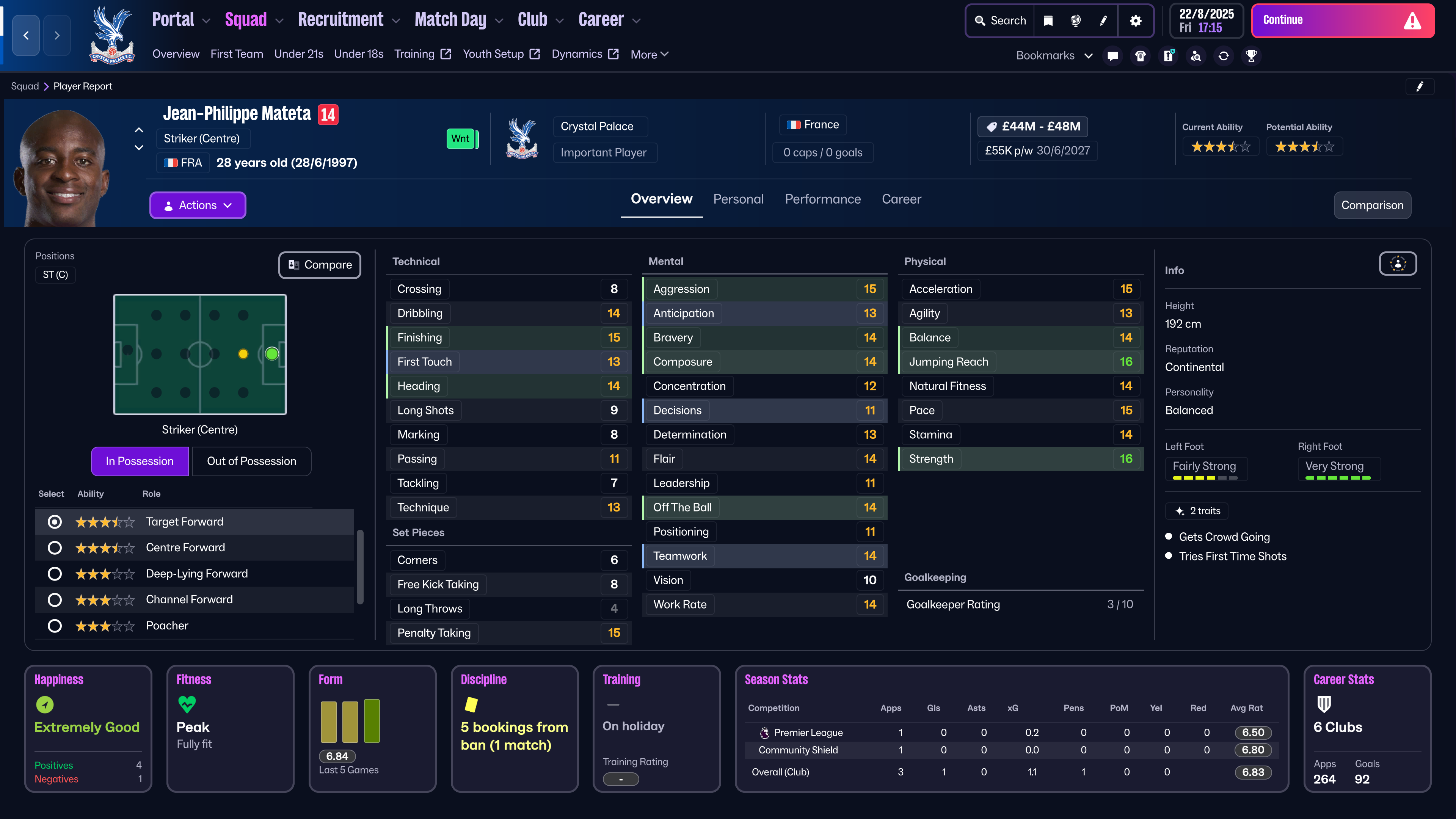
Mateta’s Attribute profile - viewed by clicking the new Attribute polygon symbol in top right section of player profile - is well-rounded. But, in this instance, we’ll play him as a Target Forward.
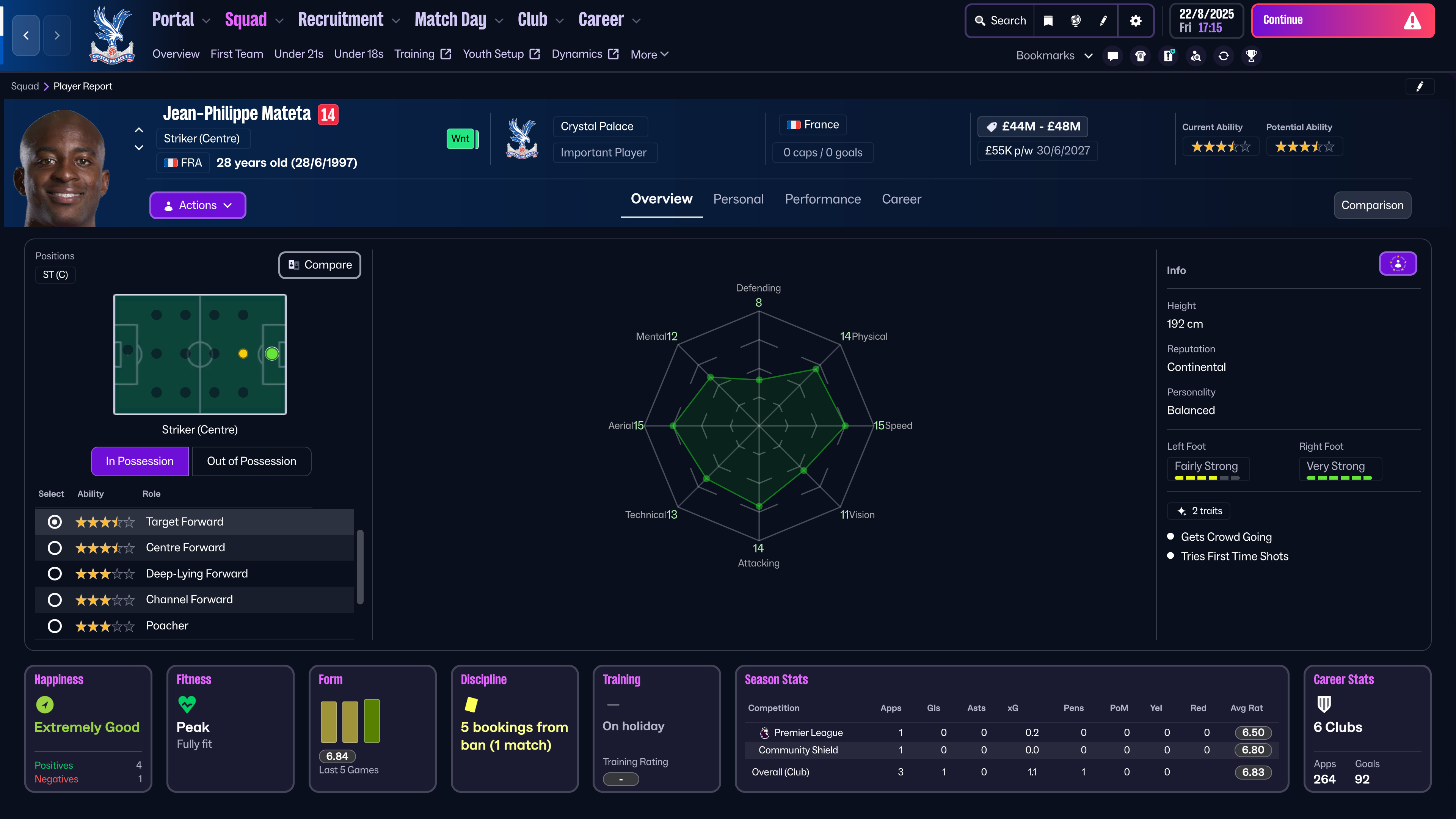
As you can see, Mateta is a striker with a balanced mix of Physical, Technical and Mental Attributes. A classic Number 9 to spearhead the attack.
If in your team, you had a player with very strong scores for Concentration and Anticipation, you might opt for the Poacher role instead. Alternatively, if they excel with their Technique, First Touch and Dribbling, the role of the energetic and dynamic Channel Forward might be stronger. The choice is always yours – just make sure you pick the role that allows your striker to use their best Attributes as much as possible.
Once you have selected your primary offensive “goal threat” striker, then the choice of their partner should reflect a role that best complements the first striker. You cannot go wrong unless you pick two exact same roles. Basically, playing with two Poachers is never a good idea. Even if you have two perfect Target Forward candidates, varying up your striker roles is still recommended. Tactical variability adds depth to your tactics – different roles have different behaviours and movement on the field which should make it more difficult for your opponent.
So, don’t ask both of your strikers to do the exact same thing. And not just strikers, no two roles in your tactic should behave the same. Instead have the roles complement each others like gears in a bigger mechanism. So while one striker holds up the ball, the other runs into channels or drops back towards the midfield to pick up the ball. As long as one of your forwards offers a goal threat, the other striker should do something different.
In this two-striker formation, Mateta lines up alongside Eddie Nketiah. Nketiah’s strengths are Technical, which makes him perfect for the Channel Forward role and hopefully a thorn in the side of any opposition defence.
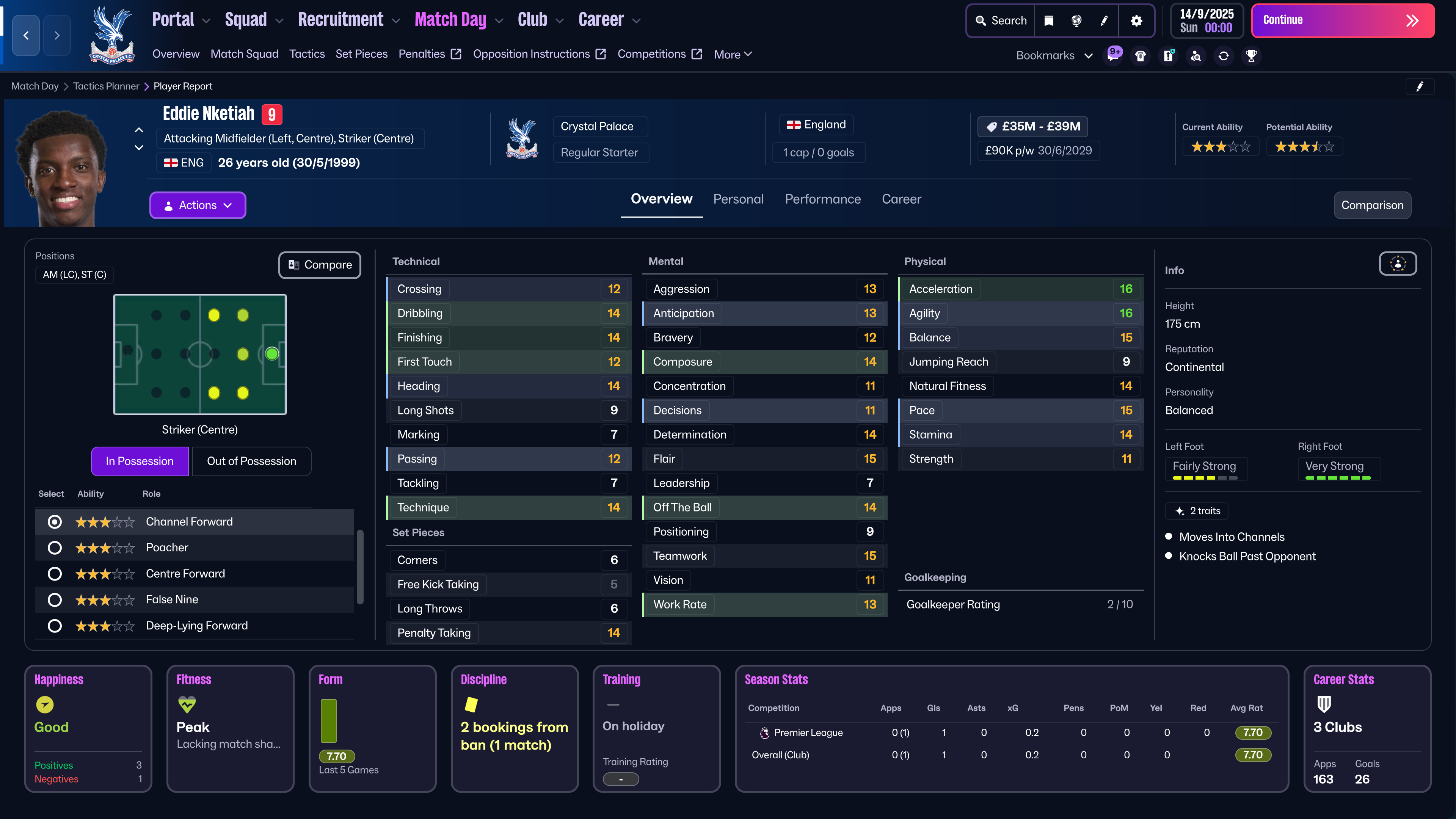
In this shape, we need to ensure that the two strikers are provided regular service from their teammates in midfield and the wide areas.
To ensure variation, we’ve got Yeremy Pino on the left-hand as a Winger with Tyrick Mitchell supporting him as a traditional Full-Back. On the right, we’ve got Ismaila Sarr as an Inside Forward so he can drift into the box with Daniel Munoz overlapping as a Wing-Back.
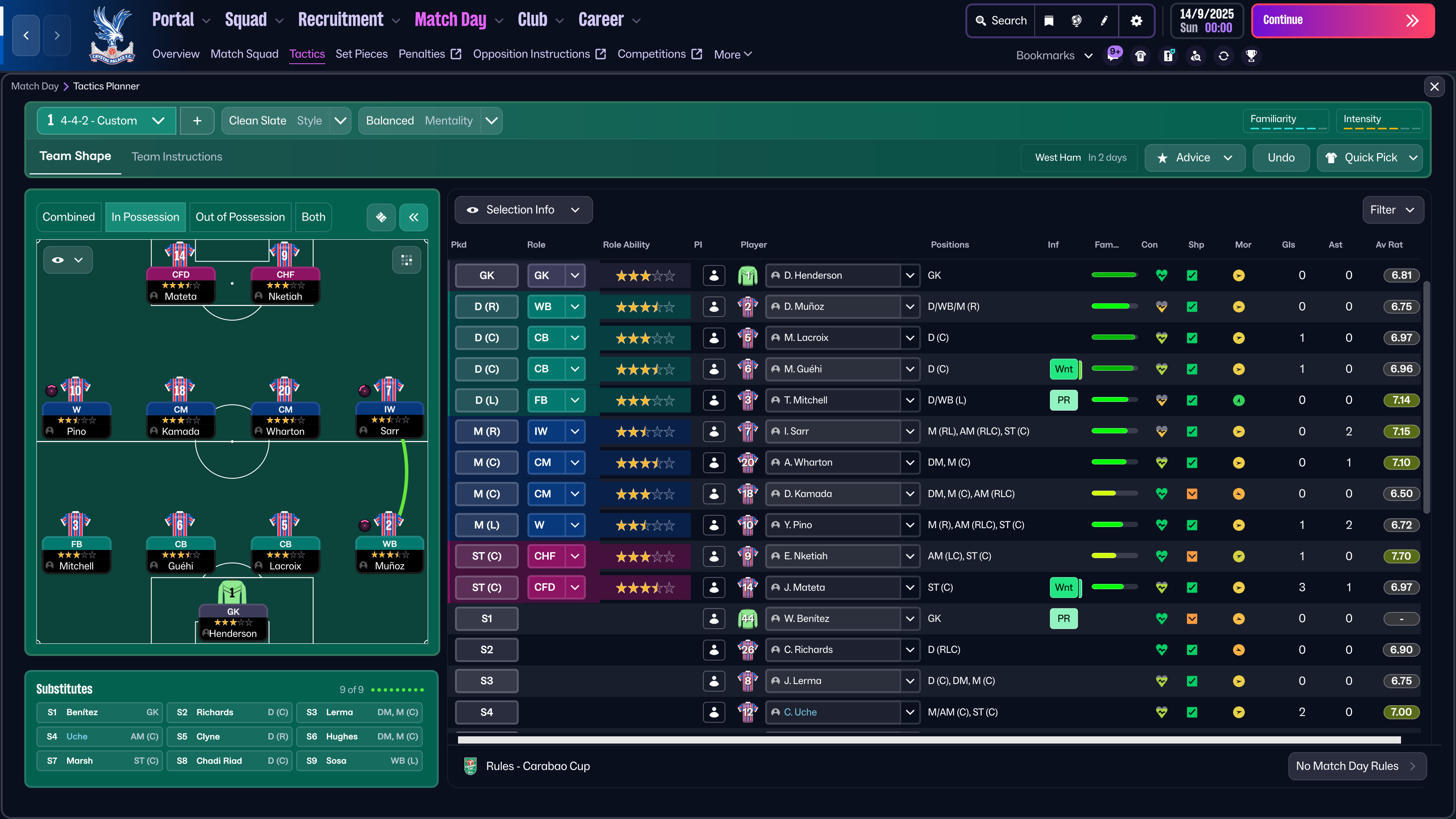
FM26’s addition of distinct In and Out of Possession formations gives you a lot more tactical depth than previous editions and it also means a fresh set of player roles.
Again, you need to analyse the player Attributes to select the role that best fits your player when not in possession of the ball.
There are three options here for you. One is the Tracking Centre Forward, which directs the striker to track back defensively, dropping back into a deeper defensive position where they can support their midfield teammates. Naturally, for a player to do well in this role, they should possess good Work Rate, Stamina and Aggression – all the Attributes that reflect working hard and covering a lot of field.
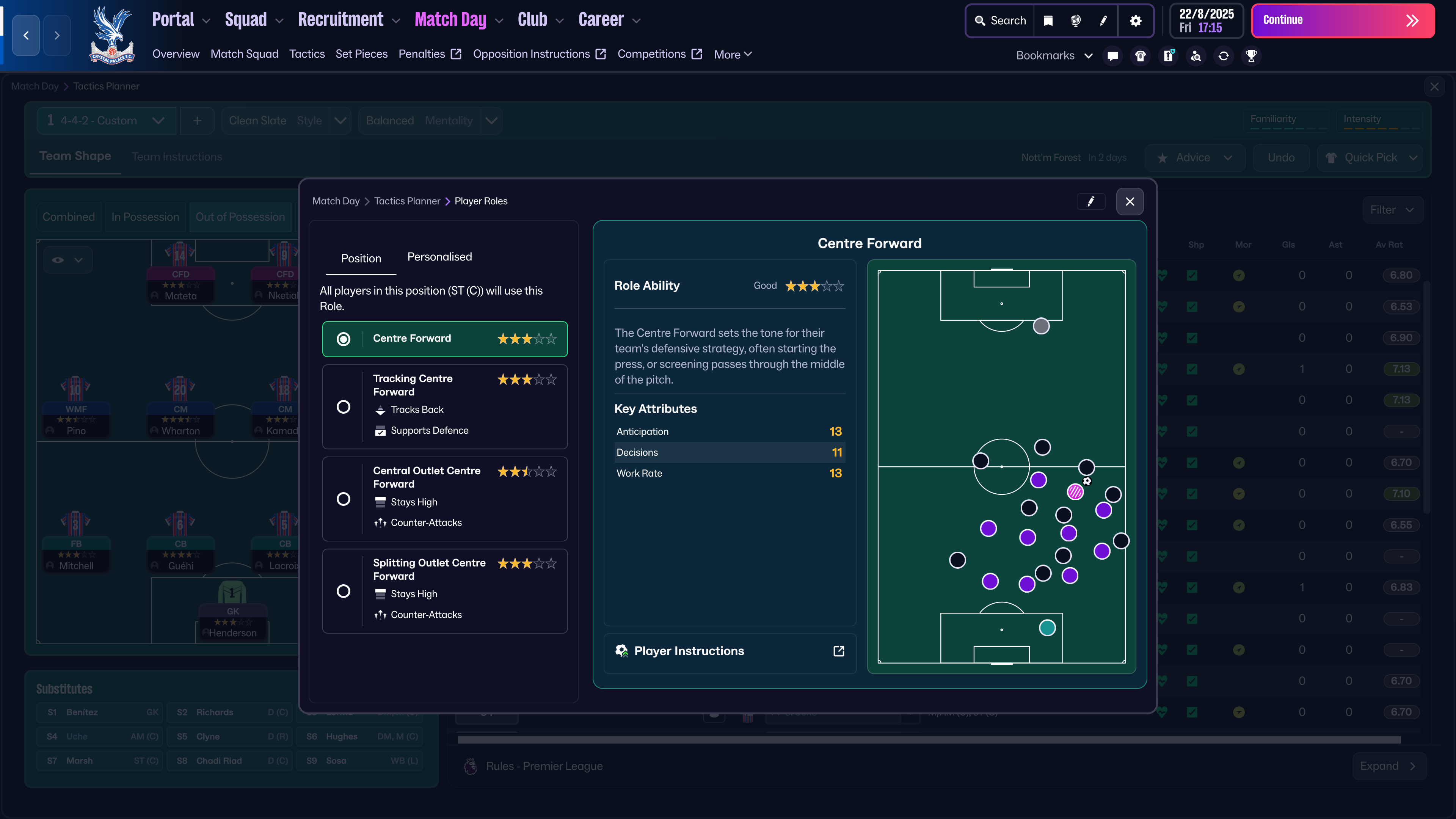
Alternatively, if their strengths lie in their speed and movement, the counter-attack focused roles of Centre Outlet Forward and Splitting Outlet Forward are more appropriate. These roles don’t require players to track back- instead, they stay high up the pitch, ready to lead the charge when a counter-attack breaks.
The benefit of playing with the 4-4-2 is that you can field one of each roles, which in turn makes your pairing a much better, more versatile tactical tool to both defend and attack effectively. In our Crystal Palace example, Mateta acts as the Tracking Centre Forward, with Nketiah staying high to make fast breaks.
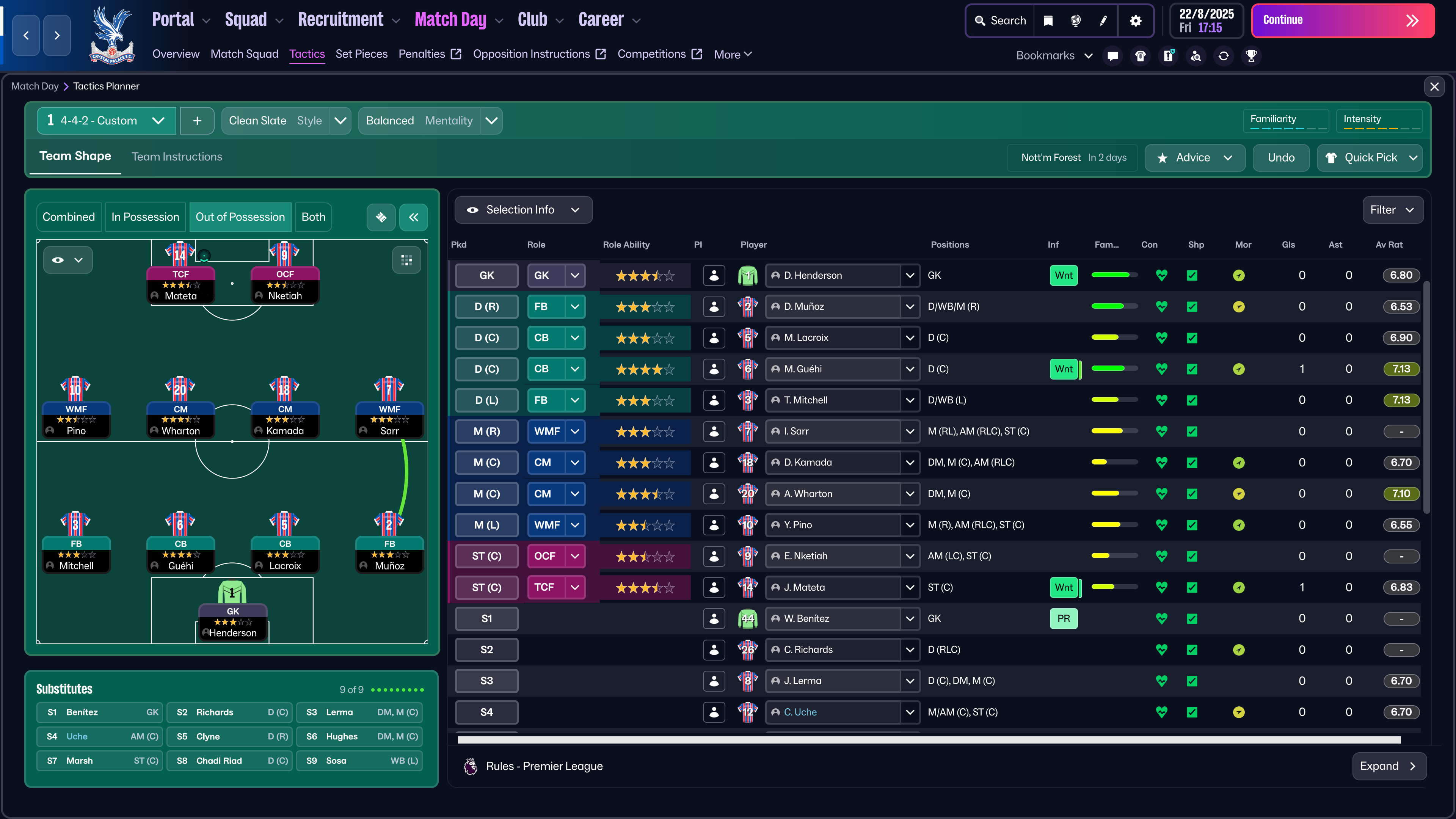
Starting your saves with a two-striker formation is a simple but effective way to hit the ground running, whoever and wherever you manage.
Let us know which role combinations you’ve had the most success with on our social channels @FootballManager.
Unlock early access to FM feature drops, news and reveals before anybody else. Plus, behind-the-scenes insights and incredible members-only giveaways.
Sign for FMFCAlready a member?

Don't Miss a Moment
Be the first to know what's next by following us across social media @FootballManager. Same handle, every platform.