In possession
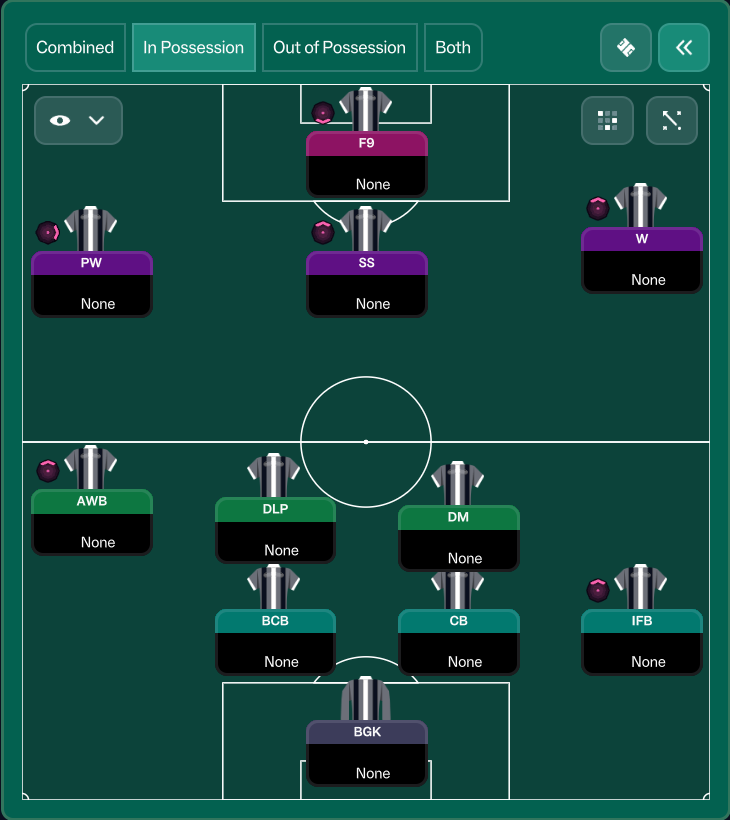
In the buildup phase, the nominal 4-2-3-1 structure morphs once stable possession is established. The defensive line compresses into a back three while the midfield double pivot anchors circulation, producing a fluid 3-2-5 or, depending on positional staggering, a 3-2-2-3 attacking structure. Within this configuration, the front four players operate as the principal agents of spatial manipulation. Their positioning, combined with the advanced movement of the wing-back on the left, generates a five-player attacking line that seeks to overload central corridors while preserving diagonal passing lanes.
The system is therefore not defined by static positional zones but by relational spacing between players. By positioning attackers along staggered diagonals relative to the ball carrier, Carrick ensures that receivers can collect possession on the half-turn with an open body orientation. This enables immediate forward progression and accelerating the tempo of circulation through the central axis.
The behaviour of the front four illustrates this principle with particular clarity. Matheus Cunha, nominally deployed from the left wing, consistently vacates the touchline and drifts into the left halfspace, functioning as an additional interior attacker between the opposition lines. This inward movement simultaneously opens the flank for an advancing full back, typically Luke Shaw, who maintains the width of the structure.
On the opposite side, Amad Diallo frequently holds a high and wide position, pinning the opposition full back and stretching the defensive block horizontally, though he retains the option to cut inside as an inverted winger when space emerges centrally. Bruno Fernandes operates as a free-roaming number ten, drifting across the attacking band to create passing triangles, often favouring the left interior channel where he can combine with Cunha and the overlapping full back.
Ahead of him, Bryan Mbeumo functions less like a fixed striker and more like a roaming forward. His movement into midfield creates overloads centrally and forces defenders into difficult decisions about whether to track him or hold their position.
Together, these rotations create a constant cycle of overloads, underlaps and late runs into space. The result is an attacking structure that feels fluid and difficult to predict rather than mechanically positional.
Out of possession
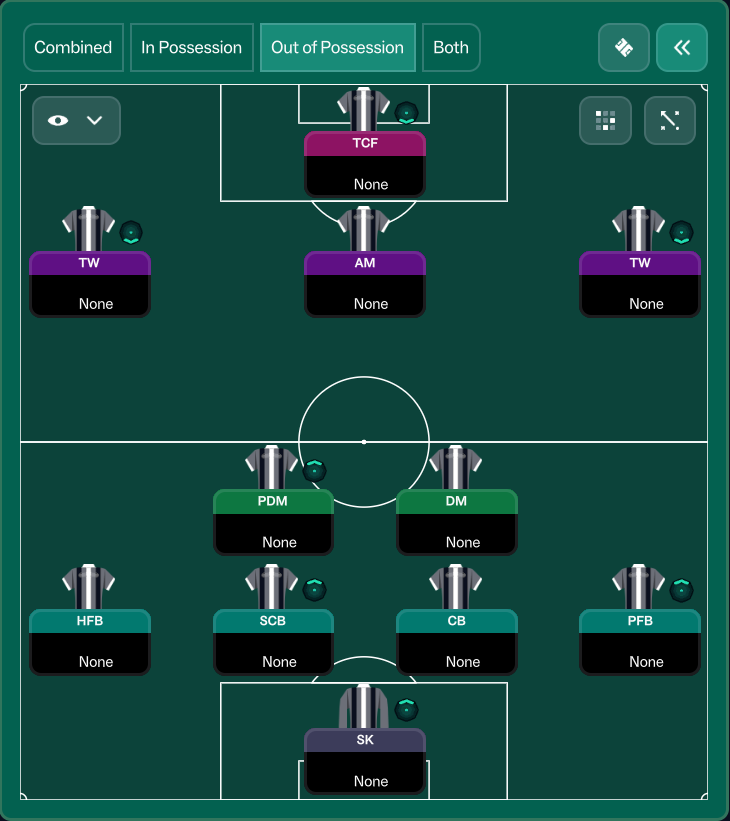
Out of possession, the structure employed by The Red Devils is defined by compactness, zonal discipline, and the systematic closure of central passing lanes. The team most commonly defends within a 4-4-2 or 4-4-1-1 block that prioritises collective organisation over aggressive individual pressing.
In this structure, Bruno Fernandes frequently advances alongside the central striker, often Bryan Mbeumo, to screen the opposition’s holding midfielder and disrupt the primary buildup channel. Meanwhile, the wide midfielders narrow their positioning to create a dense midfield line of four, effectively compressing the central corridor of the pitch. The objective of this mid-block is not constant high pressure but spatial steering.
Opponents are deliberately funnelled toward the flanks, where pressing triggers such as a heavy first touch or a backwards pass activate a coordinated press. In this sense, the defensive phase functions less as continuous pressure and more as a controlled pressing trap designed to destabilise circulation patterns at specific moments.
The structure becomes more conservative against elite opponents or during phases in which the team is protecting a lead. In such contexts, Carrick’s side can collapse into a deeper low block that occasionally resembles a 5-3-2 configuration as wide players retreat to support the full-backs.
At times, this contraction produces a compact defensive shell that observers have described as approaching a 6-2-2 shape. Regardless of the precise geometry, the guiding principle remains vertical and horizontal compactness around the central axis.
The block often allows the ball to circulate toward the least threatening opposition centre back before tightening centrally. When opponents attempt to progress through the middle, the defensive structure compresses rapidly. The front two press from the front, while the double pivot closes the space behind them. At the same time, the wide players narrow in to converge on the ball carrier. The resulting central trap neutralises vertical progression and reinforces Carrick’s broader defensive philosophy: a stable back four protected by a densely connected midfield shield that prioritises control of the centre over reactive man marking.
Team instructions
As we attempt to replicate the tactical framework of Michael Carrick in FM26, we need a coherent set of team instructions that collectively reproduce the fluid, vertically-oriented playing style associated with his interpretation of modern positional football.
Mentality
The foundational mentality is typically set to Positive, reflecting a strategic equilibrium between attacking initiative and structural security. In possession, the system prioritises rapid circulation and central connectivity.
In possession instructions
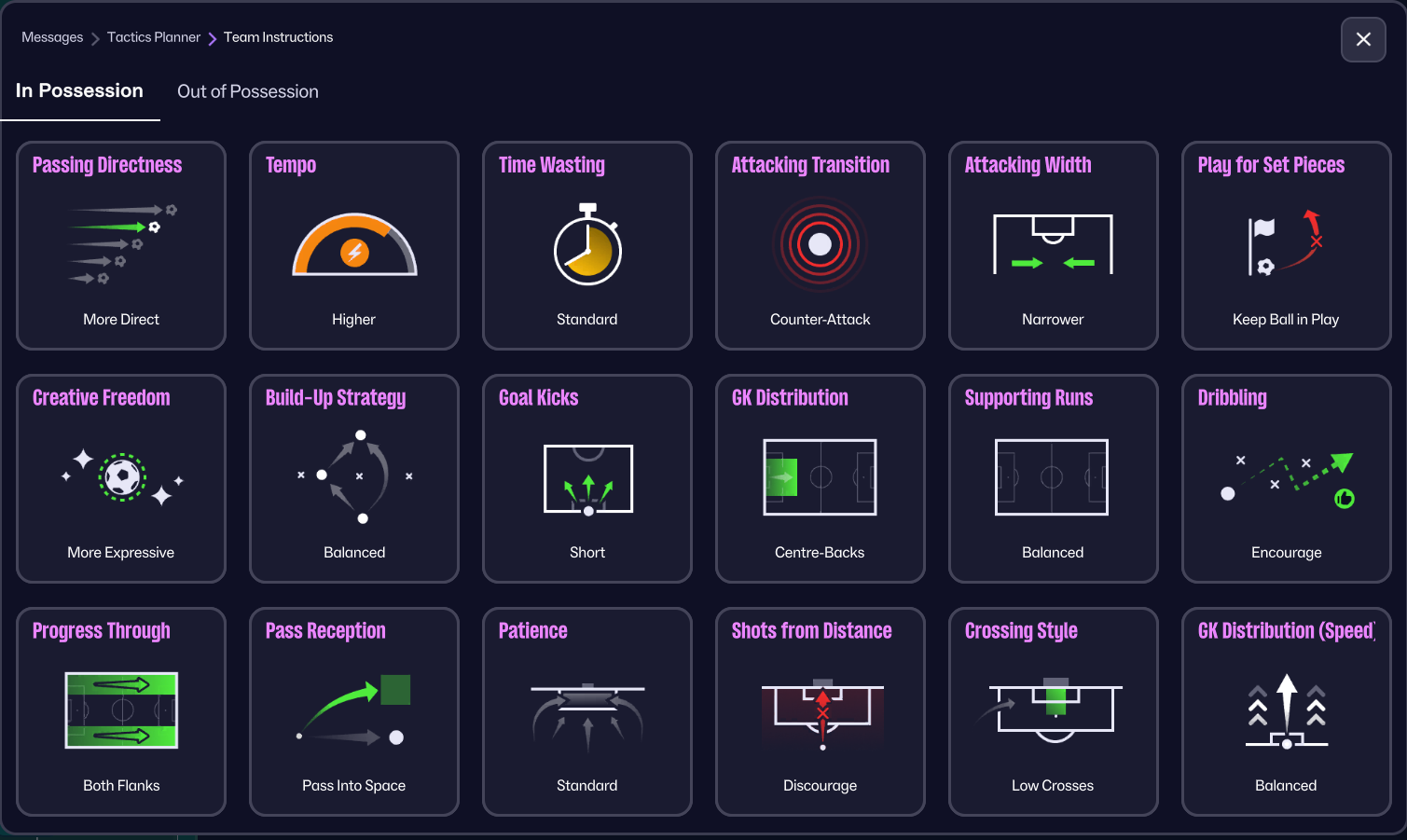
Passing directness is generally configured as Standard or More Direct, a deliberate compromise that accommodates both short combinational play through the central axis and the capacity for immediate vertical progression when transition opportunities emerge.
A Higher tempo reinforces the energetic rhythm of Carrick’s teams, while a Narrower attacking width compresses the attacking structure to facilitate short passing networks and the characteristic central overloads that underpin his positional framework.
Be More Expressive is important here too, particularly for players such as Bruno Fernandes who thrive when given freedom to improvise between the lines.
Supporting instructions such as Pass Into Space enable forward runners, including Amad Diallo or advancing full-backs, to exploit vertical channels, while asymmetrical patterns of overlapping on the left and underlapping on the right dictate that we set Progress through to Both flanks to mirror the structural imbalance frequently observed in Carrick’s attacking shape.
Goalkicks are correspondingly conservative, with instructions such as Distribute to Centre Backs initiating buildup through the defensive pairing, often involving players such as Lisandro Martínez or Matthijs de Ligt.
In the final third, the emphasis on Low Crosses reflects the absence of a traditional aerial target and instead prioritises cut-backs and driven deliveries toward arriving attackers.
Defensive instructions
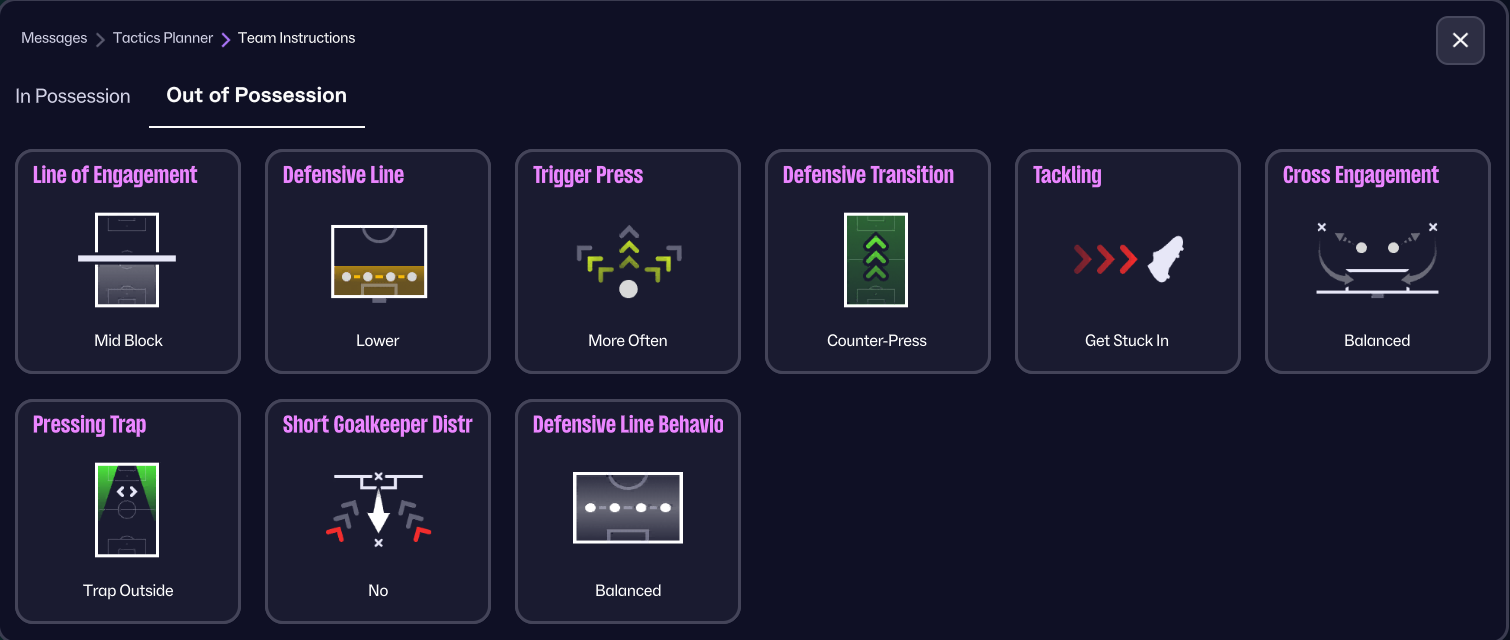
The transitional and defensive instructions further consolidate this tactical identity. During defensive transitions, Counter Press is typically activated to exploit the immediate disorganisation that follows possession loss, allowing the team to recover the ball within the compact attacking structure.
When possession is regained, Counter remains enabled to exploit the pace and forward movement of the attacking unit. Out of possession, the defensive framework adopts a mid-block with a Standard or slightly Lower defensive line, typically organised into a 4-4-2 or 4-4-1-1 structure designed to compress central spaces and invite opponents toward the flanks.
Pressing is not constant but selectively intensified through a More Often pressing trigger, ensuring that the block collapses aggressively around identifiable cues such as poor first touches or backward passes.
Trap Outside reinforces the defensive approach by steering opponents toward the flanks, while Get Stuck In increases duel intensity and helps create transitional moments higher up the pitch.
Individual instructions
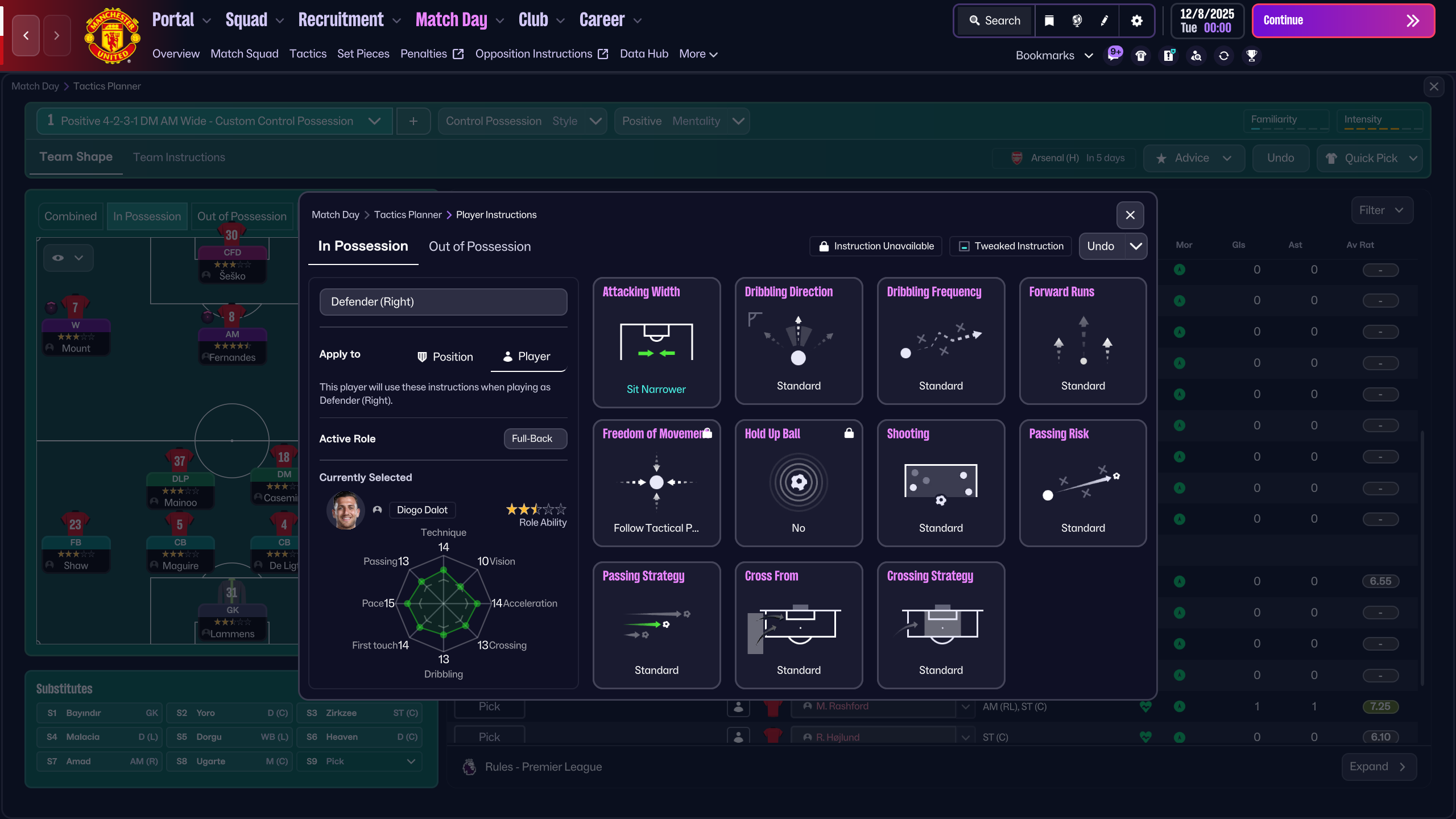
Player-specific instructions reinforce the systemic logic of the shape. A right back, such as Diogo Dalot, is instructed to Sit Narrower to support the defensive three during buildup. The left centre back maintains a wider starting position to cover advancing full-backs, midfielders, such as Kobbie Mainoo, are encouraged to Dribble More to break lines under pressure, and Fernandes receives the Roam From Position instruction to destabilise defensive structures.
And that’s how you can recreate Michael Carrick’s tactical system in FM26. If you give it a try in your own save, let us know how you get on playing his style of 4-2-3-1 on our socials @FootballManager.













Don't Miss a Moment
Be the first to know what's next by following us across social media @FootballManager. Same handle, every platform.