Spatial Spacing and Structural Manipulation
Let’s take a minute to talk about space. Specifically, how space is created before a long throw is even taken.
A throw-in does not begin when the ball is released. It starts with how players position themselves while the ball is still out of play. Space and gaps for the attacking team are not found - they are forced.
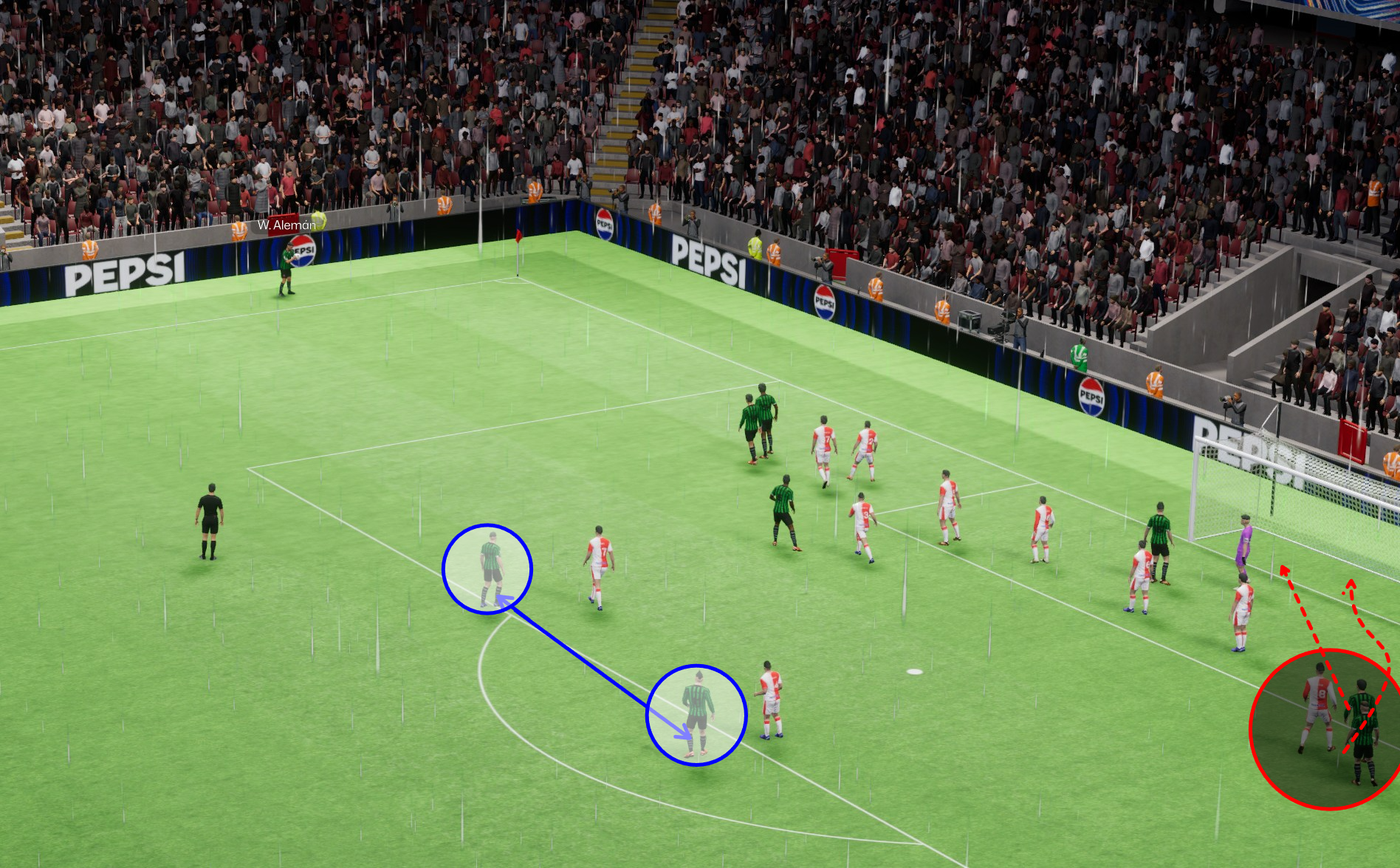
By spreading players across exaggerated horizontal and vertical distances, the attacking side stretches the defensive reference points. Defenders are no longer reacting to the ball alone, but to the threat of multiple simultaneous options. In man-marking structures, this increases marking distance. In zonal marking structures, it creates hesitation about responsibility. Both outcomes are favourable for teams looking for goalscoring opportunities.
In the example above, the defending team has opted for a mostly zonal marking setup. By stretching my setup, my runners at the far post are in a two-on-one situation. If the ball is flicked on, they stand a decent chance of getting on the end of it. If the ball is cleared, there’s a fair chance the two players at the edge of the box can win it and recycle it into the box, creating havoc.
Creating space for your players is not hard. One common technique is instructing players to come short as a decoy. By presenting as an option receive the ball, they cause the defensive block to react to the nearby threat and shift to press the obvious option. The moment this shift occurs, space opens elsewhere, usually in behind.
Another key concept is the response to marking danger men. When the defending side assigns players to mark key threats, they feel secure. In reality, it is an invitation. By moving that marked player away from where the ball is really going, the attacking team drags a strong defender with them.
What does this look like in FM26? Well, I typically assign my strongest header to mark the keeper, which in turn means he usually draws my opposition’s best header with him. Doing this opens lanes for secondary runners attacking space rather than the ball.
A stretched defensive shape is far more vulnerable to a ball delivered over distance. When defenders are spread horizontally, they lose compactness vertically. When they are dragged wide, they lose second-ball coverage centrally. Long throws exploit both failures simultaneously.
Why long throws work in FM26
The decisive moment of a long throw is what happens after the first contact. Most long throws fail because the throw is treated as the action rather than the trigger. The setup is built to win the initial duel, so when that doesn’t happen, it falls flat. With the right setup, you can score even if the initial duel is lost.
Long throws create instability as the ball arrives fast and awkwardly. FM26 allows you to benefit from this chaos by flooding the box with options. Attacking players usually have an advantage over defenders as they’re moving towards the drop zone and facing the goal rather. That advantage is created before the throw is taken, by creating a setup with plenty of movement and a solid second-ball structure.
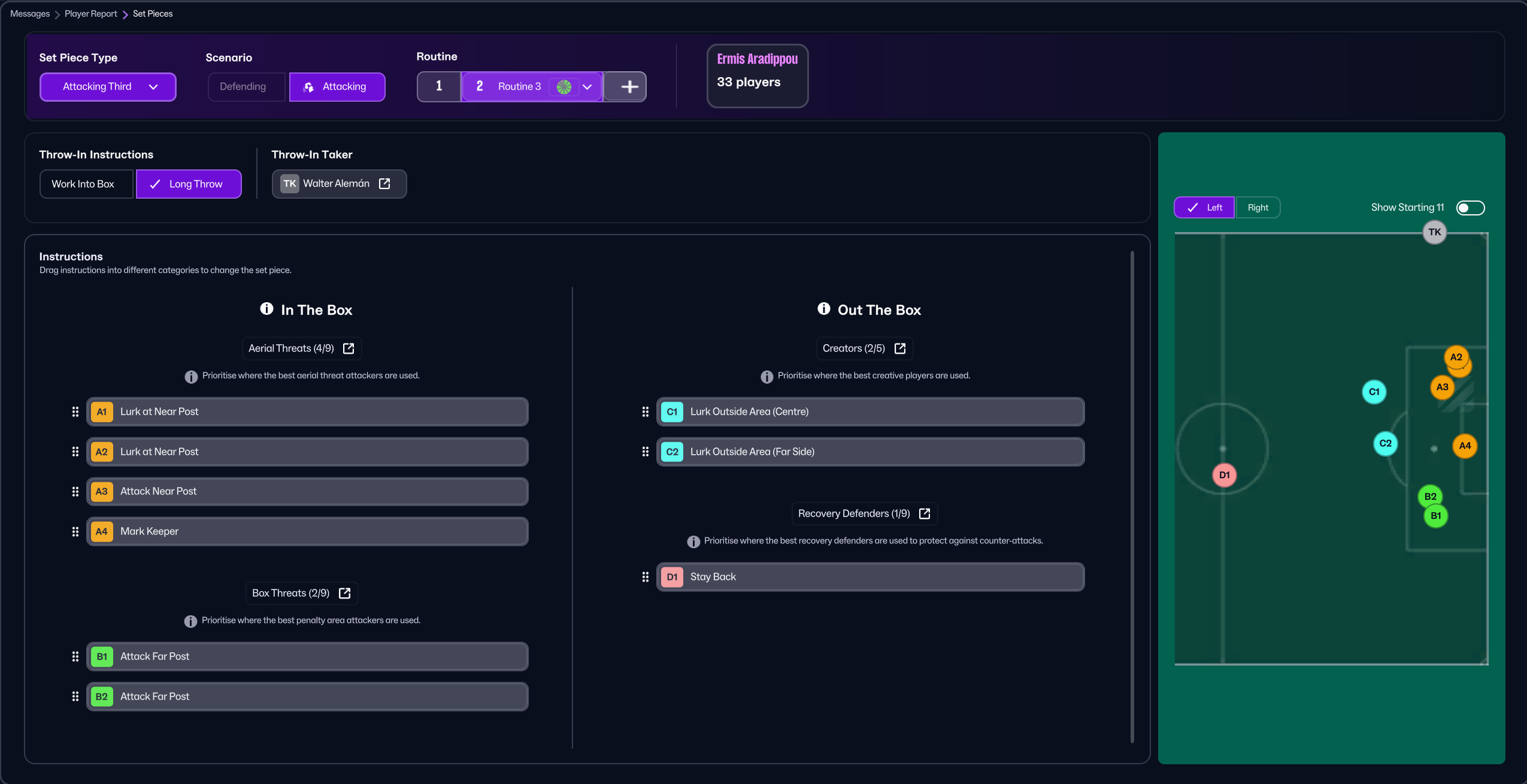
Effective long throw setups are layered, not crowded. One line attacks the first duel. A second occupies the likely drop zones. A third provides rest defence. Ideally, the objective is a direct goal. When that fails to materialise, the structure should aim for controlled possession in a destabilised defensive shape.
This means prioritising movement over height for most of the players. Jumping Reach helps, but Anticipation, Off the Ball, Aggression, and Balance decide who wins loose balls. Late-arriving midfielders are more valuable than static targets.
Well-built long throw systems resemble possession shapes, not set pieces. The team is prepared to lose the first duel because it is set up to win the second.
The delivery
The quality of a long throw routine is partially decided by the delivery. In FM26, the thrower’s role is often misunderstood. Distance alone is not enough, so you need more than just a high rating for Long Throws. A slow, high arc gives defenders time to set and jump. A fast, flat throw arrives before the defence can reset.
This is where the Long Flat Throw player preferred move matters. A long flat throw travels quicker, skids through the defensive line, and produces unstable first contact. It reduces clean headers and increases knockdowns, deflections, and loose balls. In other words, it creates the chaos long throws are designed to exploit.
The key attributes are Long Throws, Anticipation, and Decisions. The best long throwers do not force the delivery when the structure is wrong. They wait until teammates are set and the defensive shape is compressed to make the right call based on movement and opportunity.
FM26 implementation
There are a few key insights to making this work in FM26.
- Control space before the throw.
- Manipulate defensive attention.
- Prepare for the second ball.
Taking all of this into account, I usually have three setups I like to use, all slightly different, but all based on the principles listed above.
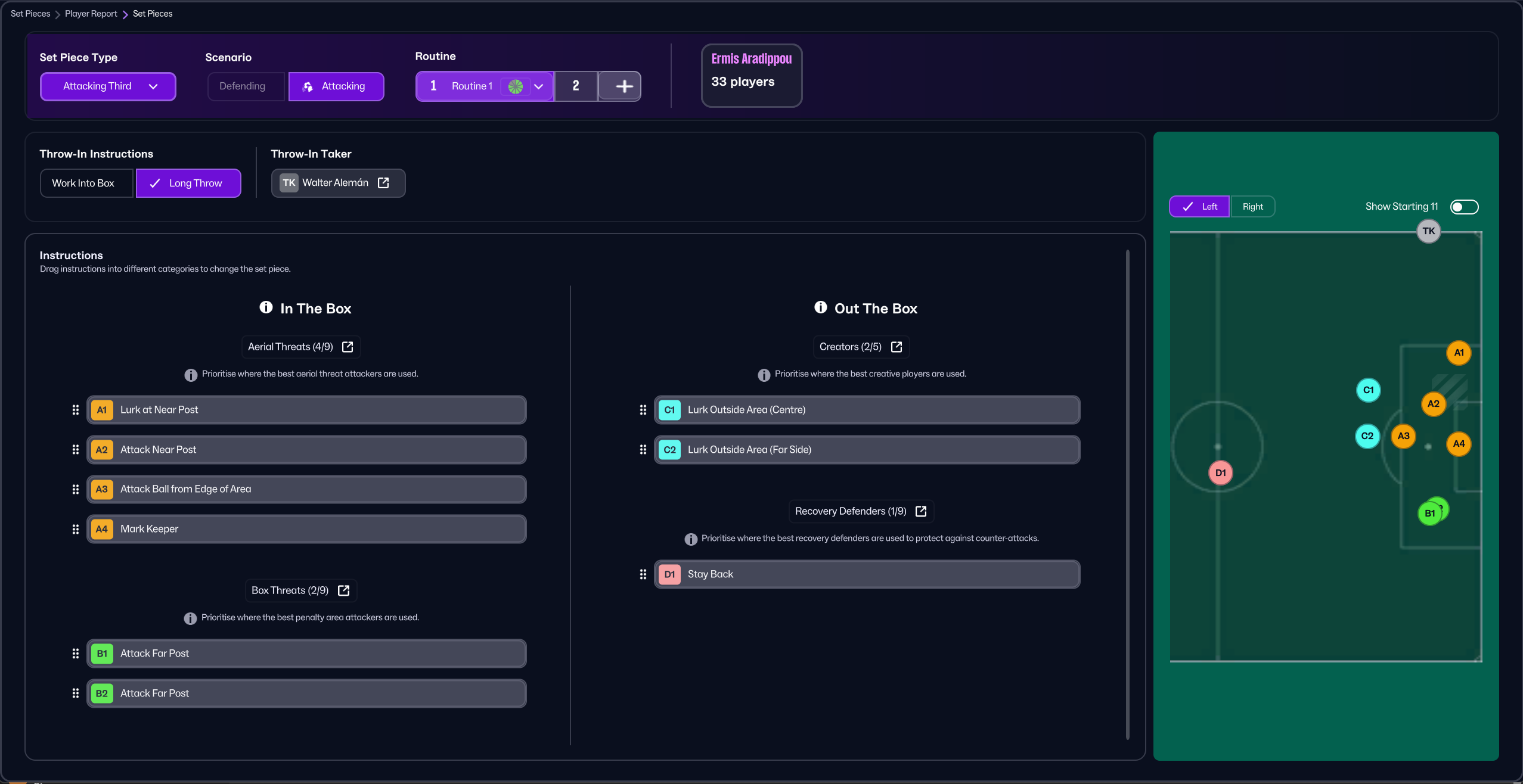
When setup properly, long throws sit alongside pressing traps, rest defence, and positional play as part of a coherent tactical identity. Their value is not defined by how often they produce goals, but by how consistently they destabilise defensive behaviour.
FM26 rewards this thinking. The key shift is perspective. Throw-ins are not isolated events. They are transition moments. Treat them as routines and they feel unreliable. Treat them as phases and they become repeatable sources of advantage.










Don't Miss a Moment
Be the first to know what's next by following us across social media @FootballManager. Same handle, every platform.